
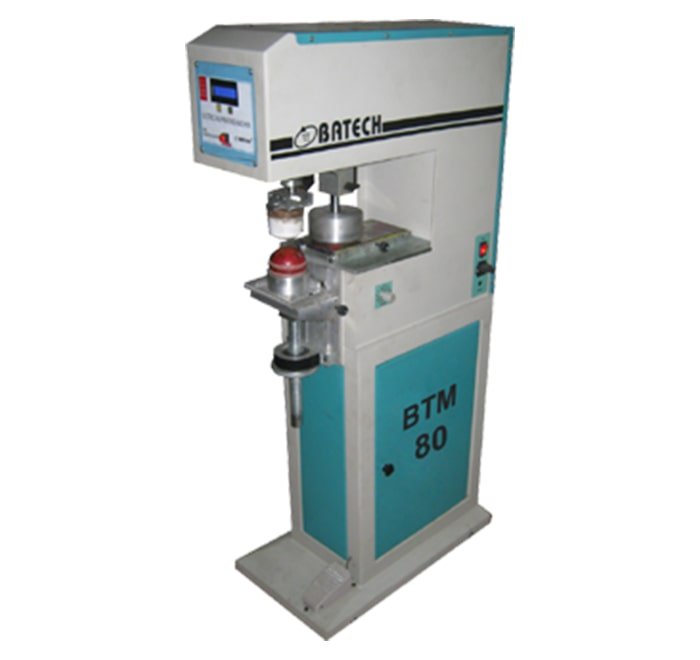
Pneumatic Single Color BTM-80
Pad printing is a printing process in which a 2-dimensional image is transferred onto a 3-dimensional object. Pad printing is used for printing on otherwise difficult to print on products in many industries including medical, automotive, promotional, apparel, and electronic objects, as well as appliances, sports equipment and toys. It can also be used to deposit functional materials such as conductive inks, adhesives, dyes and lubricants. This is accomplished using an indirect offset printing process that involves an image being transferred from the stereoplate via a silicone pad onto the base material.
The pad printing process first made a place for itself in the watch-making industry after World War II and further developments such as silicone pads and more advanced equipment were introduced in it during the late 60s and early 70s. This increased the practicality of this printing method greatly. The ability to print on previously unprintable exteriors managed to draw the attention of engineers and designers, urging them to stretch out their imagination. As a result of this, pad printing exploded into mass production, creating its own unique place in the marketplace.
Today, pad printing is a well-established technology covering a wide spectrum of industries and applications.
The Pneumatic Single Color BTM-80 is a one-of-its-kind pad printing machine with innovative technology. The printing area this model provides is of 80mm and its plate size is 100*210*12mm. This state-of-the-art model has the capacity to print 1800 pieces in one hour. This will give your production line increased speed and great efficiency.
The Motorized Single Color BTM-60ex has an electrical control which makes for easy handling of operations. It is not important to have an experienced hand in order to use this machine. It also has a power consumption of 1.3 amperes and a semi-automatic grade. The dimensions of this model are 465*265*600 w/b. This model supports an AC/DC drive and has a motor power of 0.5 HP and comes in a single colour.
The way this machine works is that a sealed ink cup is placed over the etched artwork area of the printing plate which covers the image and drowns it in ink. The inverted cup then moves away from the etched artwork area that is filled with ink and removes all excess ink in this process, leaving the etched image exposed. This allows the ink to come into contact with air which immediately leads to the ink becoming gluey, which allows it to stick to the surface of the transfer pad with ease. The transfer pad is then pressed down on the printing plate for a brief moment.
With the transfer pad compressed, the air is pushed out from the printing plate which causes the ink to lift from the etched artwork area onto the pad. The transfer pad is then hoisted and with it, the sticky ink film is also removed from the artwork area, leaving behind a small amount of ink in the printing plate. The transfer pad then moves forward along with the inverted cup, which moves over the etched artwork area on the printing plate. The ink cup again fills the etched artwork image on the plate with ink in preparation for the next cycle.
The transfer pad compresses down onto the base material which transfers the ink layer that is picked up from the printing plate to the base material. The pad then lifts off from the substrate and reverts to its original position, thus completing one print cycle.
The unique properties of the silicone pad enable it to pick the image up from a flat plane and transfer it to a variety of surfaces, such as flat, cylindrical, spherical, compound angles, textures, concave, or convex surfaces. This is a major reason why pad printing is one of the most sought after printing methods used by manufacturers.
Pad printing is a very popular printing method amongst manufacturers for its adaptability and its capacity to print on virtually any surface. It offers the same advantages, and at times even more, as screen printing and is extremely efficient. This is the go-to option for manufacturers dealing in the printing of detailed designs on normal as well as irregular surfaces.
We understand the need for optimum pad printing machines, which is why our products are made keeping in mind the robust uses the manufacturing industry has for them.
Specifications
| Printing Area(mm) | 80mm Round |
| Plate Size(mm) | 100x210x12mm |
| Speed | 1800 pcs/hr |
| Color | Single |
| Voltage | 220/110V (optional) |
| Control | Electric |
| Drive | AC/DC |
| Motor | 0.5HP, AC/DC |
| Power Consumption | 1.3Amp |
| Dimensions(mm) | 465x265x600(w/b) |
| Automatic Grade | Semi – Automatic |
| Type | Pad Printer |
There are no reviews yet.